Notes & Thoughts
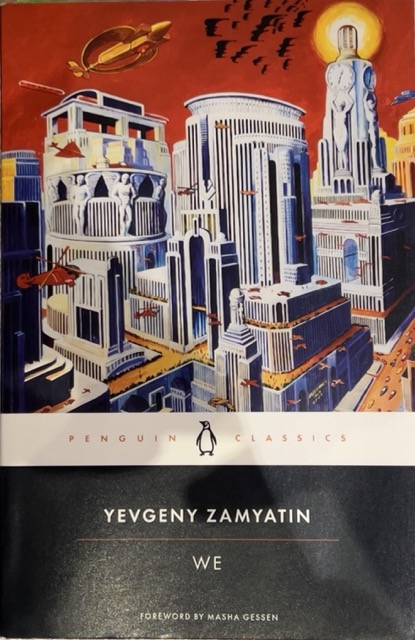
I've given this book a rating of 2 stars. I feel I might have been over generous. I'm unclear how I feel about it. I think this is in part because it was a Christmas gift from my daughter, and so for that reason I like it. I do think it is worth recognising that circumstances do play an active role in our judgements. I'm OK with that and I have no desire to be "objective" in any of these "notes and thougts". That said, the circumstances alone are not going to make this a 5 star book.
It's also a penguin classic. This means that many people have found it to be an interesting and good book - in fact a masterpiece. And for this reason I think it is worth reading. It's considered a seminal sci-fi book and was apparently an inspiration for George Orwell's 1984. I don't read purely for enjoyment - let's get that clear. Sometimes you read a book that feels like quite hard work, or is for some reason not very enjoyable, nevertheless, you benefit in some way. With novels, sometimes you are left with a feeling that's hard to explain. I'm left with such a feeling after reading this book. But I'm struggling to put it into words. Sometimes this is more satisfying than a book after which you mostly just have a sense of having enjoyed it.
I will also say, that I have the utmost respect for anyone that produces a work of art. Whether I like it or not. Making art of any kind is just an amazing thing. And it takes a lot of emotional effort. I don't think criticism is the best response to art. It's far more rewarding to try to find something in the art work that you appreciate. Perhaps if you can't, it's your fault - or in this case my fault.
Why then only 2 stars. Well, to be frank, if you handed me a proof of this book printed on A4 paper, with no context, I think I'd judge it quite harshly for a number of reasons.
Firstly, the writing is confusing. Many times, I didn't really understand the point the author was trying to make, nor how a particular sentence connected with the narrative. Take the opening of chapter 2: "It's spring. From beyond the Green Wall, from the wild plains out of sight in the distance, the wind is carrying the honeyed yellow pollen of some flower. This sweet pollen dries the lips - you keep running your tongue over them - and every woman you meet (and every man, too, of course) must have these sweet lips. This somewhat interferes with logical thought." So, he indicates here, that we are contained within a walled environment of some kind, and by the sounds of it, cut off from nature. And finally, that this is perhaps a society that values logical thought over the joy of nature. "What primitive tastes the ancients must have had", he goes on to say, "if their poets were inspired by those absurd, untidy clumps of mist, idiotically jostling one another about" - he is referring to clouds.
The bit I find somewhat odd and jarring here is the detail about the lips and tongues of every woman (and man) you meet. It feels clunky and really, could there be so much pollen around that everyone is affected by it drying the lips? And everyone walks around licking their lips? Is this information crucial at this very early point of the story? Or at all for that matter? And why do we have so much puncuation here: the dashes and brackets. And I feel if you weren't reading carefuly you might get the impression that people are running their tongues over their lips and every woman they meet (and every man too). I'm left with the impression that these sentences were dashed out and never revised.
Then we come to the final bit about interfering with logical thought. And I'm going to use it to make a more general point about the whole book. This is an early indication that the society in which our protagonist lives is one where logical and mathematical thinking is the goal, and any other modes of thought are bad. It's a society in which individual personality - having a soul - is bad. We also learn later on that we are in a society and environment designed around the panopticon model. With incognito guardians waiting to pounce on any deviates. And of course we have the great Benfactor at the head of the whole shebang.
I'm not sure I really buy this vision of dystopia. If you're going to write a book pushing back against a utopian ideology, and I'm going to take this as a book pushing back against a sort of mathematical socialist utopia, then I think you should pick a plausible distopia. But this feels like a fairly feeble unlikey dystopia. I've left it too long since reading the book to be precise, but the elevation of mathematical thinking throughout society, and the denegration and loss of poetry; I don't think this would work if you were a budding authoritarian looking for a way to control society.