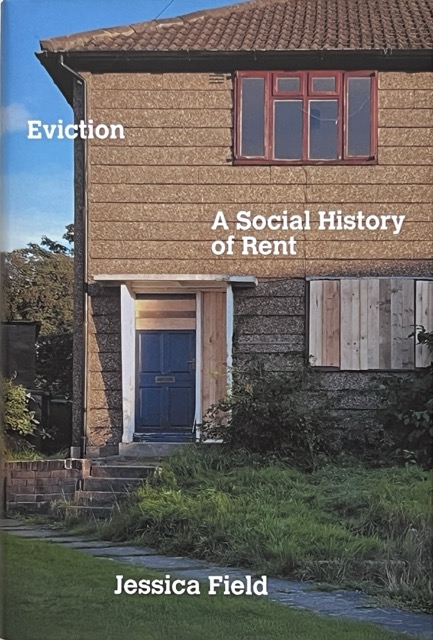
Notes & Thoughts
“Landlord power and tenant displacement have been fixtures of British housing for more than a century, even during the apparent welfare-focused years of council house building.” (Page 4)
“In fact, hundreds of thousands of post-war prefabs, including the Airey design, had a limited lifespan and therefore an inbuilt guarantee of eviction. This planned obsolescence underlines a visualisation of their inhabitants, the renting class, as moveable masses needing shelter rather than home and community - an attitude that's manifest throughout modern renting history.” (Page 8)
“I highlight how, for more than 150 years, ordinary renters have been seen by political leaders, housebuilders, investors, and industries as moveable masses - encouraged to make homes, then evicted and displaced in multiple cycles within lifetimes and between generations.” (Page 11)
“During the nineteenth and early twentieth centuries the state enabled profit-making through rented housing, turned a blind eye to the dereliction of rented properties, and then used moralising arguments to evict tenants and redevelop properties when they became slums. 'Redevelopment' became the acceptable term for tenant displacement and community dislocation.” (Page 11)
“Despite these longstanding community relationships, housing policy looks on households as separate social units - especially when it comes to eviction.” (Page 16)
“This blind spot about tenant community connections is not just a by-product of council (and now private rental) housing shortages; it has been central to a two-part logic that has long characterised the British rental sector. First is the idea that people merely occupy tenanted houses, so their personal lives are irrelevant to the management of what is legally someone else's property. Tenants are interchangeable in that sense, defined only by their ability to pay rent. Similarly, housing quality and maintenance are budget management issues, rather than a lived reality. Second is the belief that interdependence between neighbouring tenanted homes is happenstance neighbourliness rather than based on essential care relationships - and therefore also irrelevant to housing planning and management.” (Page 17)
“Tying the history and threads of the book together, I conclude by calling out the destructive impacts of 150 years of broken promises for decent and secure rented homes. We've never moved beyond the idea that a house is at the grace and favour of a landlord, whether that landlord is private, a housing association, or the state. Nor have we ever challenged the notion that displacement of the poorest in the name of progress - and sometimes even welfare - is unavoidable. We fail to see relationships across tenanted households as integral to community life. This needs to change.” (Page 20)
Seems like housing under capitalism is just exploitation of and extraction of rents from working people in order to maximise profit.
Whenever I read books that cover the history of labour movements in the relatively recent past, it strikes me that, these days, the Labour Party has really lost it's way. OK, well, that's probably an understatement and blatantly obvious to most people. I suppose what I mean is, I get this sense of a general backslide, over time, away from valuing labour and ordinary people. But not only that, even labour itself, the working class, has lost something of it's combined self-awareness. I guess this is what people mean by class consciousness. People have become less political. I was the same up until 2018 when I started to investigate the climate emergency. When I started to engage in climate activism I expected everyone would also want to do so when they knew the situation. The reality is that hardly anyone is open to activism. There are so many historical examples of political activism for all sorts of causes.
An interesting lesson from this book, is that even where government is involved in housing, even a left wing government, you still don’t necessarily get good outcomes for working people. It’s not historically the case that a left wing government will deliver good outcomes for working people. There can still be a prevailing attitude that thwarts this, e.g., the idea of the undeserving poor, or thinking of renters as individuals rather than as a community.
“The attitude of government continued to be that rented housing is at the grace and favour of a landlord, and displacement of the poorest in the name of progress cannot be avoided.” (Page 41)
Another lesson from this book (and from history), is that when you win some ground, win some concessions, win some rights, you don't get to keep them without continued work. Others will be working to take them away.
There are criticisms in the book of a lack of repairs and sometimes shoddy repairs under private management. This is no doubt driven by profit seeking management companies cutting costs. But in the personal stories in the book there are also working people exploiting people too. The rent collector adding a bit to the rent for himself. The workman doing shoddy repair work. Again I think we mustn’t assume it’s as simple as the working class vs capitalsts. There are selfish exploitative people across society (obviously). I'm noting this because I think often about how you would implement a politics of care. You can see in a variety of situations that the most thoughtful or caring people are often not the ones who are in charge. Quite often the people in power are those that seek power. This isn't really so surprising. So the question is how to set up government to prevent this. Governance structures need to have checks and balances that stop or remove the self-seeking from positions of power. Or perhaps don't even have structures in the first place that give too much power to individuals. Participatory democracy for example.
"Focus E 15 have, very publicly, taken on other housing causes beyond their hostel and their own lives. For the past decade, they’ve been campaigning to prevent the demolition of the carpenters estate in Newham.. they joined forces with the carpenters against regeneration plans group, formed in 2011 by residence who have now been fighting for well over a decade to prevent displacement. Carpenters estate residence are mainly from black and other ethnic minority backgrounds. These marginalised groups are disproportionately affected by estate demolition and renewal programs particularly around London. (Page 214)

As it happens I've been aware of the situation of the Carpenters Estate for some time. It's one of the areas in London that I've been drawn to and repeatedly photographed for some years. I don't always try to verbalise what it is that draws me to an area for photographs. There is something about social housing that makes for more intresting photos than modern housing or even the usual terraced housing. I'm not sure why that is. Perhaps because a social housing estate has an intentional architectural design aesthetic.
When I first came across the Carpenters Estate I had cycled through the regenerated Stratford Olympic Park area which seems somewhat space age and modern. I went under a bridge and onto the Carpenters Estate and literally felt like I'd gone back in time. But around the periphery are these shiny new tower blocks, so you get this strong sense of modernity squeezing in on this ancient community. You can also really get a sense of how much more the social housing estate is designed to foster community compared to the modern predominently glass developments. There are plenty of outdoor communal spaces. Sadly you can also see how years of austerity have resulted in decay in both the communal spaces and the housing. I guess this is partly why it's an interesting area to photograph. There is a visible story.


"Renters deserve the chance to make homes marked by genuine affordability, stability, and social connection. It might not sound like a revolutionary idea, but it requires a radical transformation of how we think about housing – one prioritises people over profit, security over speculation, and tenant communities over landlord commodities. (Page 243)
I made a short video recently of the Carpenters Estate. It begins with a few shots from the redeveloped Olympic Park side before dropping in to the estate, so you can get a sense of the transition. The video was filmed on an old Canon G3 digital camera (2001).